Jim Rawley
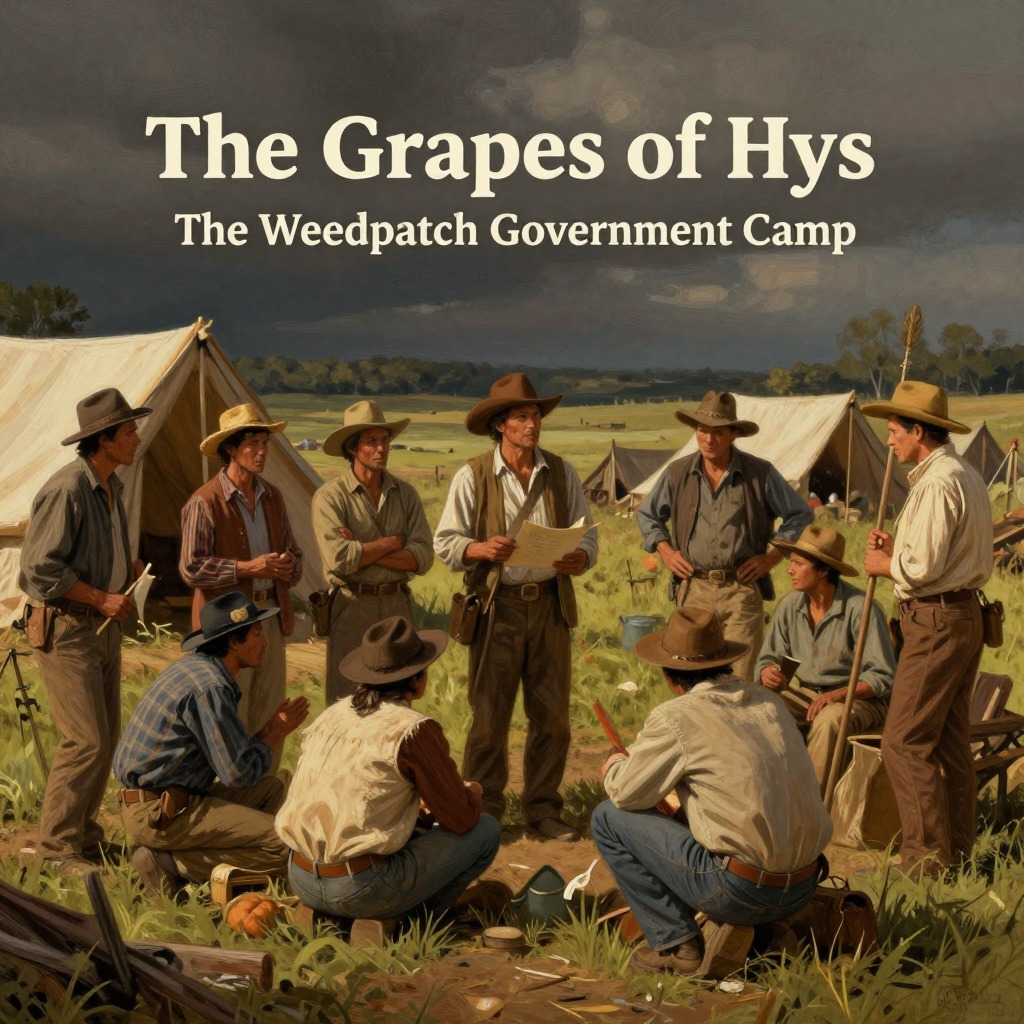
Jim Rawley is the manager of the Weedpatch government camp, a model Farm Security Administration facility in Kern County, California. He embodies a humane, democratic alternative to the hostile treatment migrants face elsewhere, and his quiet, respectful interactions with the Joads—especially Ma Joad—demonstrate the camp's philosophy of self-governance and dignity.
Identity and Role
Rawley is introduced as a "little man dressed all in white" with a "thin, brown, lined face and merry eyes," as lean as a picket, and his white clean clothes are frayed at the seams. He is the camp manager, but he immediately disclaims any authoritarian role, telling Ma Joad that "the people here worked me out of a job. They keep the camp clean, they keep order, they do everything." His appearance and manner are deliberately unthreatening; he squats on his hams to drink coffee with Ma, and his frayed clothing signals that he is not a distant bureaucrat but someone who shares the migrants' material circumstances. He is based on the real-life Thomas Collins, Steinbeck's chief source of migrant information, whom the novelist portrayed with photographic accuracy.
Method and Philosophy
Rawley's approach to camp management is founded on respect and self-governance. He tells Ma that the camp's committees—elected by the residents—make the laws, keep order, and handle disputes. No cop can enter without a warrant. When a religious zealot, Mrs. Sandry, terrorizes Rose of Sharon with predictions of divine punishment, Rawley intervenes not by ordering her out but by explaining to Ma that the woman "isn't well" and asking Ma to try not to hit her. He understands that the camp's stability depends on the residents' own restraint, not on his authority. He also quietly counters the same woman's accusations by telling Rose of Sharon that the girls who lost their babies did so because they were "too hungry and too tired" and "rode on a truck over bumps," not because of sin. His method is to defuse fear with fact and compassion.
Relationship with the Joads
Rawley's first encounter with Ma Joad is a masterclass in building trust. He arrives at her campfire, compliments her coffee, and accepts a cup, squatting on his hams to drink it. He calls her "Mrs. Joad" repeatedly, a small courtesy that restores her sense of dignity after the dehumanization of the road. Ma later reflects that "that manager, he come an' set an' drank coffee, an' he says, 'Mrs. Joad' this, an' 'Mrs. Joad' that—an' 'How you gettin' on, Mrs. Joad?'" She concludes, "Why, I feel like people again." When the Ladies' Committee visits, Rawley has already paved the way by telling Ma that the committee members "came in the same way" and understand the newcomers' situation. His presence reassures the Joads that the camp is a place where they will be treated as human beings.
Significance
Rawley represents the possibility of a just social order within the novel's otherwise bleak landscape of exploitation and violence. The Weedpatch camp, under his guidance, functions as a proof-of-concept for democratic self-organization among the dispossessed. His character is a direct contrast to the deputies, vigilantes, and corporate farmers who treat migrants as subhuman. By showing that a government camp can be run without coercion, Rawley implicitly critiques the system that burns Hoovervilles and pays starvation wages. His quiet effectiveness also underscores the novel's argument that the migrants themselves, when given the chance, are capable of governing their own lives with dignity and order.